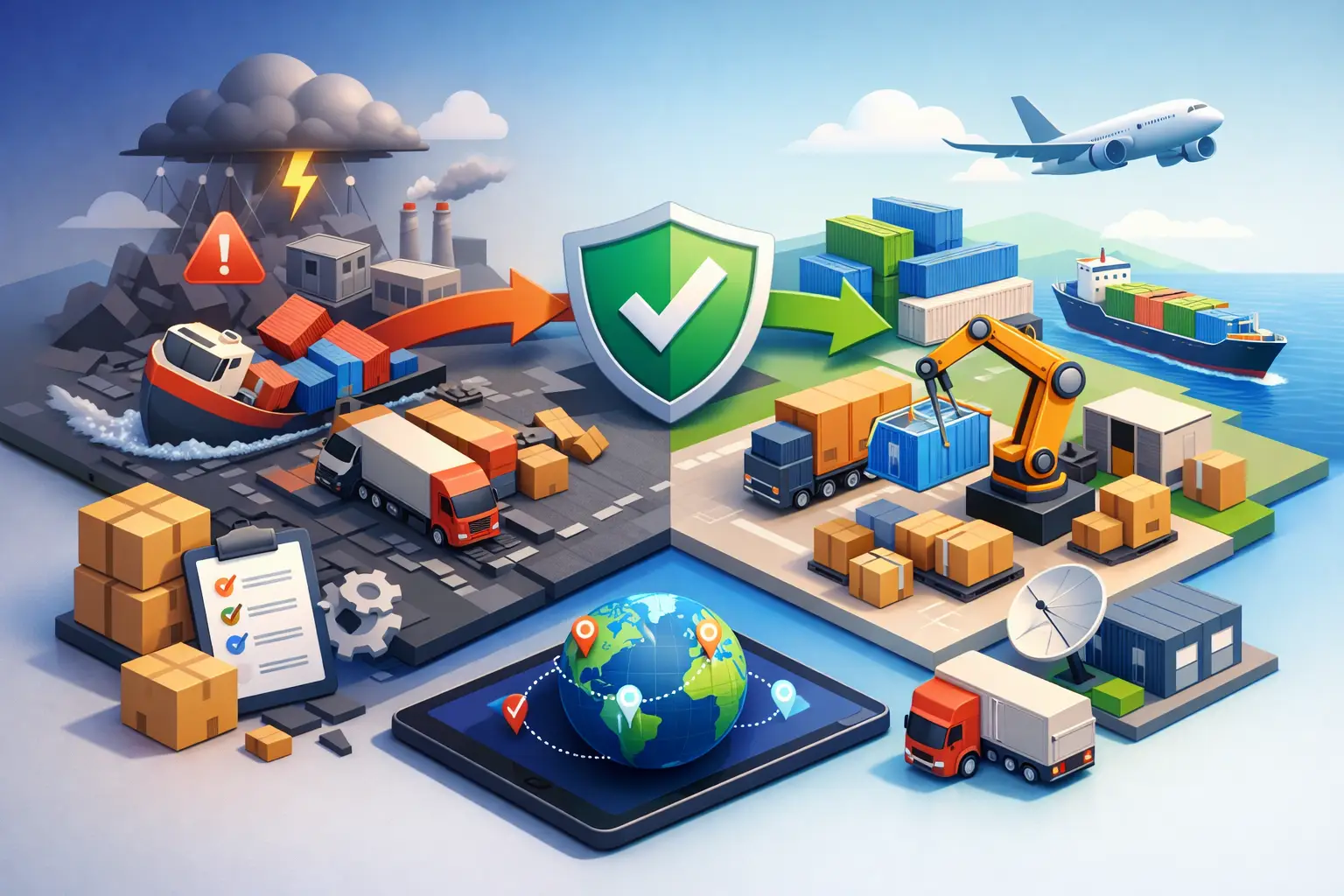
When a critical supplier fails, a port closes, or a key component stops moving across borders, the real damage is rarely confined to procurement. Revenue exposure escalates, customer obligations come under strain, regulatory commitments may be tested, and executive teams are forced into decisions with incomplete information. That is why supply chain disruption response must be treated as an enterprise resilience capability, not a narrow operational fix.
For senior leaders, the question is not whether disruption will occur. It is whether the organisation can absorb the shock, maintain control, and recover in a way that protects value. A delayed shipment can often be managed. A poorly governed response, by contrast, can turn a contained interruption into a wider operational and reputational event.
Why supply chain disruption response often fails
Most organisations do not lack effort during a disruption. They lack structure. Teams work hard, but they work in parallel rather than in concert. Procurement chases suppliers, operations revises schedules, customer-facing teams make promises, finance models exposure, and leadership receives fragmented updates. The result is delay at the point where speed matters most.
A second weakness is over-reliance on single-tier visibility. Many firms know their direct suppliers reasonably well but have limited understanding of tier-two and tier-three dependencies, regional concentration risk, logistics bottlenecks, or single points of failure in shared infrastructure. When disruption hits beyond the immediate supplier base, response options narrow quickly.
There is also a governance issue. In many businesses, the threshold for escalating a supply issue into a formal incident is unclear. Teams wait too long, hoping a local fix will hold. By the time the issue reaches executive attention, inventory buffers are depleted, customers are affected, and options are more expensive.
A practical framework for supply chain disruption response
Effective response depends on decisions being made in sequence, under clear authority, and against pre-agreed priorities. The strongest organisations do not improvise the framework in the middle of a crisis. They activate one.
1. Establish incident ownership early
A supply disruption should have a named incident lead as soon as material impact is plausible, not only when damage is certain. That lead needs authority to coordinate across procurement, operations, logistics, legal, communications, and business continuity. Without this role, the organisation defaults to functional silos.
Ownership should also be proportionate. Not every late delivery warrants crisis-level mobilisation. The discipline lies in defining trigger points. Those may include expected stock-out dates, contractual service risk, production downtime forecasts, regulatory exposure, or concentration of customer impact. Clear triggers prevent both overreaction and dangerous delay.
2. Stabilise the operating picture
Leadership needs one version of the truth. In the first hours of a disruption, that means confirming what has happened, which sites, products, customers, and obligations are affected, and what assumptions remain unverified. Precision matters more than volume. A concise operational picture is more useful than a large report built on uncertain data.
This stage is often undermined by poor data discipline. Different teams hold different numbers for inventory, lead times, and order commitments. A controlled response requires validated information and explicit confidence levels. If a data point is uncertain, say so. False certainty is one of the costliest features of incident response.
3. Prioritise business-critical outcomes
Not all products, customers, or facilities carry equal importance. A mature supply chain disruption response distinguishes between what must be protected and what can be deferred. That requires decisions anchored in business impact, not internal politics.
For some organisations, priority may sit with regulated service delivery or safety-critical operations. For others, the issue is preserving key account commitments or protecting high-margin product lines. There is no universal hierarchy. What matters is that the hierarchy exists before pressure rises.
4. Activate response options, not just analysis
Once critical outcomes are defined, the organisation needs executable alternatives. These may include approved substitute suppliers, alternate transport routes, revised production sequencing, temporary specification changes, inventory redeployment, or controlled customer allocation. The quality of response depends on whether these options have already been assessed for operational, legal, quality, and regulatory viability.
This is where many continuity plans are exposed. They identify risk in broad terms but do not convert it into practical playbooks. A supplier alternative that has not been commercially vetted or quality-approved may not be a real option at all.
Governance matters as much as logistics
Supply disruptions are often framed as a sourcing problem. In practice, they are governance tests. Senior management must be able to show that decisions were timely, structured, and aligned to the organisation’s risk appetite and obligations.
Escalation and decision rights
A common point of failure is confusion over who can approve extraordinary spend, authorise customer prioritisation, accept temporary control changes, or notify regulators. If these authorities are unclear, teams hesitate. If they are too loose, inconsistent decisions follow. Strong governance does not slow response. It gives response legitimacy and speed.
Board and executive visibility
Not every disruption belongs at board level, but material events require disciplined oversight. Boards should understand exposure concentrations, resilience assumptions, and the status of major incidents without becoming involved in operational micromanagement. Executive teams, meanwhile, need concise reporting that supports decision-making rather than retrospective assurance.
This is where an integrated resilience model has value. Supply chain response should connect to enterprise risk, crisis management, and business continuity rather than sit in isolation. Organisations that build these capabilities separately often discover the gaps only under stress.
What resilience looks like before disruption occurs
The quality of response is largely determined before the event. Preparation does not eliminate disruption, but it expands room to manoeuvre.
Better dependency mapping
Businesses need a realistic picture of critical dependencies across suppliers, contract manufacturers, logistics routes, utilities, digital systems, and people. In Asia-Pacific operations, this should include cross-border exposure, customs constraints, geopolitical sensitivities, and regional concentration risk. Dependency mapping is not a theoretical exercise. It informs where to diversify, where to hold buffer capacity, and where to set tighter monitoring.
Scenario-led planning
Generic continuity documents rarely help when a plant goes offline or a trade corridor is restricted. Scenario-based planning is more effective because it forces teams to work through decision pathways. What happens if a sole-source component fails for three weeks? What if inbound materials clear customs but outbound distribution is blocked? What if a supplier remains operational but falls out of regulatory compliance?
These scenarios expose practical issues early, including contract limitations, approval bottlenecks, and communications gaps.
Exercising under pressure
Tabletop exercises remain one of the most efficient ways to test supply chain disruption response. The value lies not in rehearsing a perfect script, but in testing authority, timing, information flow, and decision quality. The right exercise should create pressure, ambiguity, and competing priorities because that is how real incidents behave.
For executive teams, this also builds confidence in escalation thresholds and reporting lines. It is easier to act decisively when the leadership group has already worked through hard trade-offs together.
The trade-offs leaders need to confront
There is no disruption strategy without cost. Greater resilience may require dual sourcing, additional inventory, broader supplier assurance, or investment in visibility and response capability. Those choices can pressure margin in the short term.
The alternative, however, is not cost-free. Lean networks with limited redundancy can perform efficiently in stable conditions but become fragile under stress. The right balance depends on sector, customer tolerance, contractual obligations, and regulatory context. A pharmaceutical business, a financial infrastructure provider, and a consumer goods distributor will not make the same resilience choices, nor should they.
Leaders should also be honest about where standardisation helps and where flexibility is worth preserving. Highly centralised procurement can deliver control and leverage, but may slow local response if exceptions require too many approvals. Decentralised models can move faster, yet create inconsistency and hidden exposure. The answer is usually structured flexibility: common governance with delegated authority at the right points.
Moving from reaction to control
A credible supply chain disruption response is not measured by whether disruption can be avoided altogether. It is measured by how quickly the organisation can establish control, protect priority outcomes, and make defensible decisions under pressure.
That requires more than supplier management. It requires governance clarity, incident discipline, business continuity alignment, and leadership readiness. For organisations operating across regulated and operationally complex environments, this is a board-relevant resilience issue.
The strongest response posture is built before the next disruption tests it. If your current model depends on individual heroics, informal workarounds, or late escalation, it is carrying more risk than it appears. Control comes from structure, and structure is what allows an organisation to keep operating when conditions no longer cooperate.