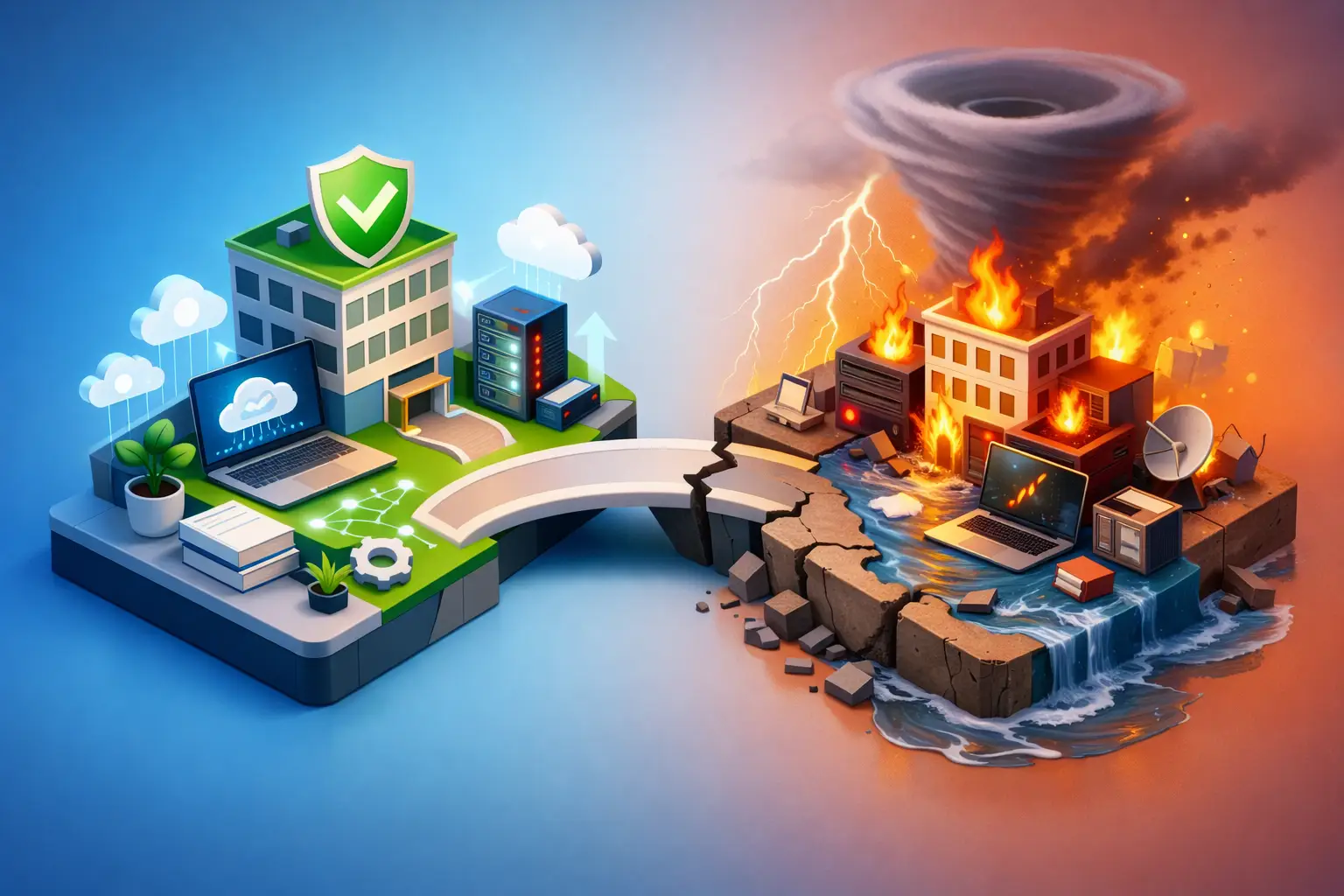
When a regional outage halts customer channels at 9.15 on a Monday, the first question is rarely academic. Leadership needs to know who is making decisions, which services must be restored first, how long disruption can be tolerated, and what must keep operating in the meantime. That is where business continuity versus disaster recovery stops being a terminology debate and becomes a matter of control.
Many organisations still use the two terms interchangeably. That creates gaps at exactly the wrong moment. A disaster recovery plan may help restore systems, but it will not by itself sustain customer communications, manual workarounds, supplier coordination, regulatory reporting, or executive decision-making. Business continuity, by contrast, is broader. It protects the operating model while the disruption is still unfolding.
For senior leaders and risk owners, the distinction matters because each discipline answers a different management question. Business continuity asks how the organisation continues to deliver its critical activities during disruption. Disaster recovery asks how disrupted technology, data, infrastructure, or facilities are restored to an acceptable state. One protects continuity of operations. The other restores the capabilities that support those operations.
Business continuity versus disaster recovery: the core difference
Business continuity is an enterprise discipline. It focuses on maintaining critical products, services, processes, and decision structures when normal conditions are no longer available. That includes people, premises, third parties, governance, communications, and alternative methods of delivery. Its concern is not limited to whether systems are online. It is concerned with whether the organisation can still function in a controlled, defensible way.
Disaster recovery is narrower and more technical. It is primarily concerned with recovering IT services, applications, infrastructure, networks, data, and in some cases physical technology environments. It defines what must be restored, in what order, by whom, and within what timeframe. In most organisations, it sits within technology resilience, though its consequences are firmly operational and commercial.
The practical distinction is simple. If an event affects your ERP platform, disaster recovery addresses restoration of the platform and its supporting architecture. Business continuity addresses how finance, procurement, operations, customer service, and leadership continue to work while that restoration is taking place. You need both. Treating one as a substitute for the other is a common and expensive error.
Why the confusion persists
Part of the confusion comes from history. In many organisations, continuity planning began as an IT-led activity because technology failures were highly visible and measurable. Recovery time objectives, backup schedules, failover arrangements, and server restoration tests produced clear metrics. Business continuity often remained attached to that technical agenda rather than being developed as a cross-functional management capability.
Another reason is ownership. Technology teams typically have clearer structures, budgets, and procedures for recovery than business units have for sustaining operations under stress. As a result, executive teams may assume that a tested disaster recovery environment means the organisation is resilient. It does not. A successful systems recovery can still coincide with operational paralysis if staff lack workarounds, decision rights are unclear, vendors cannot perform, or regulatory communications are delayed.
There is also a governance issue. When continuity and recovery are handled in isolation, each function may optimise for its own objectives. IT may restore systems according to technical dependencies, while business leaders require a different sequence based on customer obligations, revenue protection, or regulatory exposure. Without integrated resilience governance, those priorities can conflict during an incident.
What business continuity covers
Business continuity begins with understanding critical activities and the impact of their disruption. That usually involves business impact analysis, dependency mapping, recovery priorities, minimum service levels, and tolerable downtime. From there, the organisation defines how those activities will continue if people, systems, sites, suppliers, or information flows are compromised.
The scope is wider than many continuity documents suggest. It includes alternate working arrangements, role substitution, emergency communications, critical records access, supplier escalation, customer messaging, crisis governance, and procedures for operating at reduced capacity. In a mature framework, it also addresses decision thresholds, escalation paths, and management assumptions that can be pressure-tested before a live event occurs.
This is why business continuity belongs at management level, not only within operations. It is as much about prioritisation and authority as it is about process. During a serious disruption, someone must decide what is protected first, what is temporarily suspended, what risk is acceptable, and how the organisation explains its position to staff, customers, regulators, and the board.
What disaster recovery covers
Disaster recovery is the discipline of restoring disrupted technology services in line with business requirements. That includes infrastructure recovery, application restoration, data recovery, network reconfiguration, cyber incident restoration, backup validation, and sometimes workplace technology readiness. It should be built around business-defined tolerances, not technical convenience.
Two measures are often central. Recovery time objective defines how quickly a service must be restored. Recovery point objective defines how much data loss is tolerable, measured back from the point of disruption. These are not purely technical settings. They are business decisions with cost implications. A near-zero recovery objective may be justified for payment systems, but unnecessary for a low-priority internal platform.
Good disaster recovery planning also deals with dependencies. Recovering a single application is not enough if authentication services, network routes, data feeds, or third-party platforms remain unavailable. The test of disaster recovery is not whether technology components can be switched on, but whether they can support a controlled return of business operations.
Where each discipline sits in a resilience framework
A resilient organisation does not place business continuity and disaster recovery in competition. It positions both within a wider framework of enterprise risk, crisis management, operational resilience, and governance oversight. That matters because disruptions rarely stay inside one functional boundary.
A cyber event, for example, is not only a technology issue. It may trigger customer service degradation, legal obligations, media scrutiny, board escalation, and third-party disruption across several jurisdictions. Disaster recovery may restore certain systems, but business continuity determines how the organisation functions while recovery is under way. Crisis management coordinates executive decisions, communications, and stakeholder control. Governance ensures accountability and oversight.
This integrated view is especially relevant for organisations operating across Asia-Pacific, where supply chain concentration, cross-border regulation, outsourced service models, and regional incident exposure can complicate response. In such environments, resilience cannot be reduced to an IT recovery runbook.
Common failures when the distinction is misunderstood
The first failure is overconfidence. An organisation may believe it is prepared because backups exist and recovery tests have been completed, yet critical teams have never rehearsed manual operations or cross-functional decision-making. When a real event occurs, technical restoration proceeds, but the business still loses time through confusion and poor coordination.
The second failure is misaligned priorities. Technology recovery may focus on system architecture, while the business needs to preserve a specific client-facing service or regulatory process first. If those priorities are not reconciled in advance, recovery may technically succeed while commercial or compliance damage grows.
The third failure is weak executive involvement. Business continuity is sometimes delegated too far down the organisation, treated as documentation rather than management infrastructure. That creates plans without authority. Under pressure, teams need approved priorities, defined tolerances, and clear escalation structures.
How to align business continuity and disaster recovery
Start with the business, not the systems. Identify the services, obligations, and activities that the organisation must protect. Define acceptable downtime, minimum operating levels, and material impacts. Then map the technology, people, premises, suppliers, and information needed to support those priorities.
From there, continuity and recovery plans should be built to the same set of business assumptions. If a process must be available within four hours, disaster recovery should support that target and business continuity should define how the process operates until full restoration is achieved. Plans should not be written in parallel without shared priorities.
Testing is where alignment becomes real. Tabletop exercises, scenario rehearsals, and technical recovery tests should be connected. It is not enough to prove that infrastructure can be restored. The organisation should test whether leadership can make timely decisions, whether business units can work around outages, whether third parties can meet obligations, and whether communications remain controlled.
This is also where an advisory-led resilience model adds value. Firms such as Jacob Business Armour help organisations connect continuity, recovery, crisis response, and governance into one decision-ready architecture rather than a stack of separate plans.
Which should be prioritised?
It depends on the organisation’s exposure. A digital-first business with high transaction dependency may need significant investment in disaster recovery capabilities first. A complex service business with multiple manual dependencies and regulatory obligations may gain more immediate value from strengthening business continuity and crisis governance. Most established enterprises require both, but not always at the same level of maturity or at the same pace.
What should not happen is a false choice. If your systems recover but your operations cannot function, resilience has failed. If your teams improvise operational continuity but your recovery capability is weak, disruption will last longer than necessary. The board should expect both disciplines to be aligned, tested, and governed against clear business priorities.
The useful question is not whether business continuity is more important than disaster recovery, or the reverse. The useful question is whether your organisation can continue to make sound decisions, protect critical services, and restore key capabilities under real operating pressure. If the answer is uncertain, that is where the work starts.