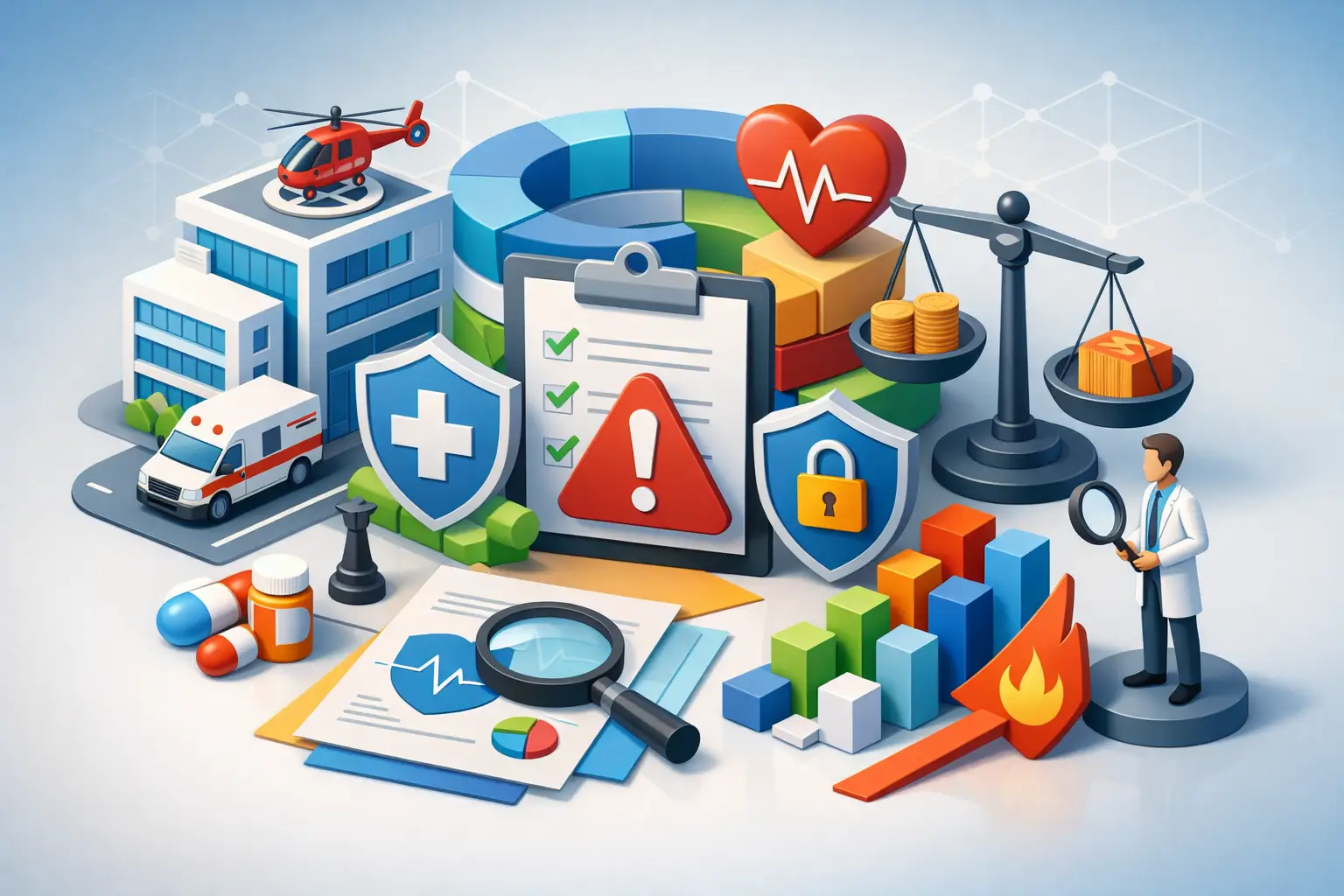
A serious patient safety event rarely stays confined to one department. It can trigger regulatory scrutiny, disrupt operations, expose leadership decisions, affect insurer relationships and damage public trust in a matter of days. That is why the question of what is enterprise risk management in healthcare matters well beyond compliance. For healthcare leaders, it is a question of how risk is identified, understood and governed across the whole organisation.
What is enterprise risk management in healthcare?
Enterprise risk management in healthcare is a structured approach to identifying, assessing, managing and monitoring risks that could affect an organisation’s objectives, service delivery, financial stability, regulatory standing and reputation. It moves risk management away from isolated departmental activity and places it within an enterprise-wide framework supported by leadership, governance and clear accountability.
In practical terms, ERM in healthcare brings clinical risk, operational risk, cyber risk, workforce risk, financial risk, legal exposure, supply chain disruption and reputational issues into one decision-making model. Instead of treating each risk in a separate silo, the organisation considers how risks interact, which ones matter most, and what level of exposure is acceptable.
This is particularly important in healthcare because a single disruption often has cascading effects. A cyber incident may delay treatment, affect patient records, create reporting obligations, increase legal exposure and place executives under immediate pressure. ERM is designed to give leadership a clearer line of sight before those pressures become a crisis.
Why healthcare organisations need an enterprise view of risk
Healthcare is one of the few sectors where operational failure, governance weakness and human harm can converge at the same time. A manufacturing delay may be costly. A clinical service failure can be costly, reportable and life-affecting all at once.
That reality makes fragmented risk management difficult to defend. Many providers still have capable teams managing infection control, health and safety, information security, insurance, audit and compliance. The weakness is not usually the absence of effort. It is the absence of integration.
An enterprise approach helps boards and executive teams answer harder questions. Which risks could interrupt critical services? Where are control gaps building across different functions? Are risk owners escalating issues consistently? Is the board receiving a true view of exposure or a filtered one?
For organisations operating across multiple sites, jurisdictions or care settings, these questions become even more pressing. Local issues can become enterprise risks quickly, particularly where regulatory frameworks, workforce pressures and digital dependencies overlap.
The core components of enterprise risk management in healthcare
A credible ERM framework is not a register full of generic entries. It is a governance system that supports disciplined decisions. In healthcare, that usually begins with risk taxonomy and risk ownership. The organisation needs a common language for risk categories and clear accountability for managing them.
Risk identification comes next, but it must be broader than incident reporting. Historical events matter, yet they only show where the organisation has already been exposed. Effective ERM also examines strategic plans, operational dependencies, external threats, service changes, vendor concentration, workforce vulnerabilities and regulatory developments.
Risk assessment then evaluates both likelihood and impact, but healthcare organisations should be careful not to reduce everything to a simple scoring exercise. Some low-frequency risks carry intolerable consequences. Others are common but manageable. The context matters, particularly where patient safety, licence conditions or critical service continuity are involved.
Treatment planning follows assessment. That may involve stronger controls, revised escalation pathways, continuity arrangements, crisis protocols, insurance review, technology investment or policy change. Not every risk should be eliminated. Some must be accepted, provided leadership understands the exposure and the basis for that decision.
Monitoring and reporting complete the cycle. This is where many frameworks lose momentum. If reporting is too technical, boards cannot use it. If it is too high-level, emerging issues are missed. Good ERM reporting gives senior leaders enough visibility to challenge assumptions, allocate resources and act early.
What risks fall within ERM in a healthcare setting?
The short answer is all material risks to organisational objectives. In healthcare, that usually includes clinical quality and patient safety, workforce availability, data protection, cyber security, medical equipment reliability, third-party risk, financial sustainability, compliance, facilities resilience and executive decision risk.
Reputational exposure also belongs in the framework, but it should not be treated as a standalone communications problem. Reputation is often the result of failures elsewhere - weak controls, delayed response, poor governance or inconsistent stakeholder communication.
There is also a strategic layer that can be overlooked. Expansion plans, mergers, digital transformation, outsourcing and service redesign all introduce risk. ERM should support these decisions, not sit behind them as an afterthought.
How ERM differs from traditional risk management in healthcare
Traditional risk management in healthcare often centres on claims, incidents, workplace safety or compliance obligations. Those remain important, but they do not provide a complete view of enterprise exposure.
ERM differs because it connects risk to strategy, governance and resilience. It asks whether the organisation can continue critical operations under pressure, whether leadership has accurate escalation channels, and whether risk appetite is defined in a way that supports decision-making.
That distinction matters. A hospital may comply with required controls and still be poorly prepared for a major system outage. A care provider may manage local incidents adequately and still miss the concentration risk created by one critical supplier. ERM looks across the whole risk landscape rather than managing symptoms in isolation.
Governance is the difference between theory and control
If ERM is treated as a reporting exercise, it will produce paperwork rather than protection. In healthcare, the framework only works when governance is clear.
The board sets expectations for oversight and risk appetite. Executive leadership translates those expectations into operational practice. Risk owners manage exposures within their remit, while assurance functions test whether controls are working as intended. This sounds straightforward, but in many organisations the lines are blurred.
One common issue is escalation fatigue. Teams report repeatedly, but no one is sure when a local issue becomes an enterprise concern. Another is uneven maturity across functions. Cyber risk may be managed tightly while supplier resilience remains underdeveloped. Governance must bring consistency without forcing every risk type into the same mould.
This is where specialist resilience advisers such as Jacob Business Armour can add value - not by replacing internal ownership, but by helping organisations build integrated structures that connect enterprise risk, continuity, crisis management and governance into one operating model.
What good ERM looks like in practice
A strong healthcare ERM programme is visible in decision quality before it is visible in documents. Leaders know which services are most critical, which dependencies are fragile and which risk exposures need board attention. Risk reporting is current, decision-led and linked to action.
There is also alignment between ERM and business continuity. That connection is essential. Knowing that a risk exists is not enough if the organisation cannot sustain priority services when disruption occurs. Similarly, crisis management should not sit separately from enterprise risk. If a major event unfolds, escalation, authority and communication should already be defined.
Good ERM also accepts that not all healthcare organisations need identical structures. A private hospital group, aged care provider, public health institution and specialist clinic network will face different exposures and governance demands. The framework should be tailored to complexity, regulatory pressure and operational scale.
Common implementation mistakes
The first mistake is treating ERM as a compliance project. That usually leads to static registers, weak engagement and poor executive use. The second is overcomplicating the model. If scoring systems, categories and committee structures become too elaborate, the framework loses traction.
Another common problem is separating strategic risk from operational reality. Strategy risk does not sit above operational detail. It depends on it. If workforce fragility, outdated systems or supplier dependency are ignored, strategic plans rest on unstable foundations.
Finally, some organisations assume incident data alone will reveal their main exposures. It will not. Incident data is useful, but enterprise risk management also requires horizon scanning, scenario thinking and scrutiny of near-misses, control failures and external change.
A more useful question for leaders
Rather than asking only what is enterprise risk management in healthcare, leadership teams should ask whether their current approach gives them enough control over disruption, accountability and recovery. That is the standard that matters.
Healthcare organisations do not need more risk language for its own sake. They need a disciplined framework that helps protect patients, maintain operations, support regulatory confidence and give boards a defensible basis for oversight. When ERM is designed properly, it does not sit at the edge of the business. It becomes part of how the organisation stays stable under pressure.
For senior decision-makers, that is where risk management stops being an administrative function and starts becoming a resilience capability.