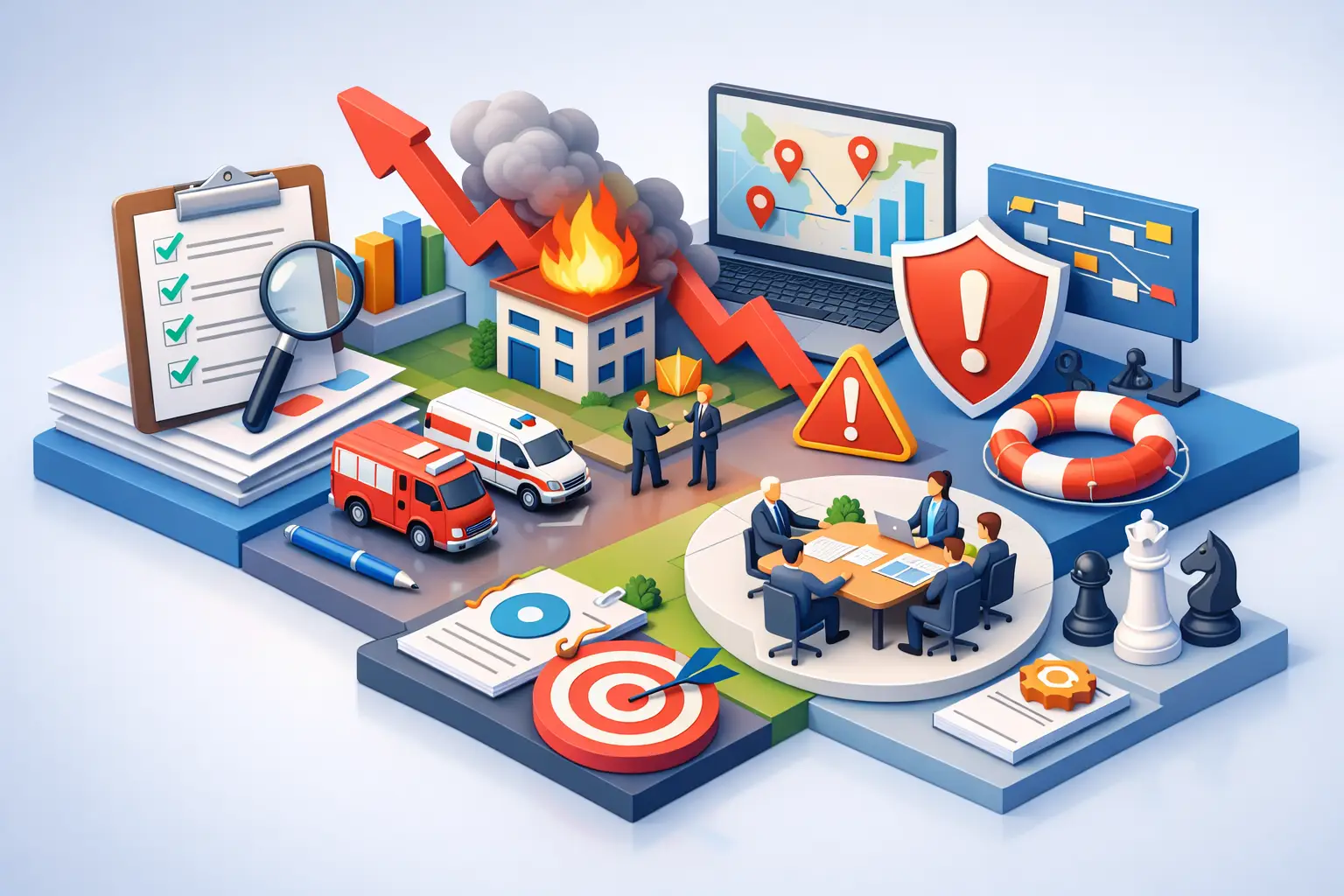
A cyber attack at 08:15, a regulator enquiry by lunch, and social media scrutiny before the board has assembled - this is where weak planning becomes visible. The most useful crisis response plan examples are not polished documents created for audit files. They are decision frameworks that help leadership protect people, operations, obligations and enterprise value under pressure.
For most organisations, the issue is not whether a crisis plan exists. It is whether that plan reflects the realities of the business, the speed of escalation and the decisions executives will actually need to make. A generic template may satisfy a requirement, but it rarely supports confident action in a live incident.
What strong crisis response plan examples have in common
The best plans are structured around leadership decisions, not just incident descriptions. They define who can declare a crisis, who leads the response, what thresholds trigger escalation and how information moves between operational teams, executives, legal advisers and governance stakeholders.
They also recognise that crises do not unfold neatly. Early information is incomplete, internal reporting is often inconsistent and external scrutiny can arrive before facts are confirmed. A practical plan therefore needs enough structure to create control, but enough flexibility to deal with ambiguity.
In regulated and operationally complex environments, that balance matters. A plan that is too high level creates delay. A plan that is too detailed can become unusable when conditions change.
Crisis response plan examples by scenario
Different crisis types require different response patterns. The examples below are not sector-specific scripts. They show how an organisation might structure leadership, escalation and action around common crisis events.
1. Cyber security breach response plan
A cyber crisis plan usually begins with a distinction that many businesses fail to make clearly: not every cyber incident is a crisis. The plan should define when an IT security issue becomes an enterprise event, such as when core systems are unavailable, customer data is exposed, criminal activity is suspected or regulatory notification may be required.
In a strong model, technical containment remains with cyber and IT teams, while the crisis leadership group focuses on business priorities. That includes assessing operational disruption, authorising external communications, protecting evidence, managing legal exposure and deciding whether to activate continuity arrangements.
The trade-off here is speed versus certainty. If leadership waits for complete forensic findings, it may lose control of customer messaging and regulatory timing. If it acts too early, it may issue inaccurate statements. The plan should therefore define what can be approved on a provisional basis and who has authority to make those calls.
2. Product recall or customer safety incident plan
For organisations with manufacturing, distribution or consumer-facing operations, a product-related crisis plan needs to align operational response with legal and reputational control. The central question is not just whether a defect exists, but whether there is a credible risk to customer safety, compliance standing or brand trust.
A workable plan sets out how affected stock is identified, how distribution channels are contacted, how decision-makers assess recall thresholds and how customer guidance is approved. It also establishes a disciplined record of actions taken, which becomes important if regulators, insurers or litigants later review the response.
These incidents often involve tension between commercial instinct and risk judgement. Some leadership teams hesitate because recall decisions are costly and public. Yet delay can increase harm and intensify scrutiny. The plan should make clear that the primary objective is risk containment, not short-term revenue preservation.
3. Executive misconduct or governance crisis plan
Some of the most damaging crises begin not in operations, but in leadership conduct. Allegations involving fraud, harassment, bribery, conflicts of interest or disclosure failures can destabilise governance rapidly, particularly where the subject is a senior executive or board member.
This type of plan needs stronger governance safeguards than most. It should specify who receives allegations, how independence is preserved, when external investigators or counsel are engaged and how decision-making is separated if the usual crisis leader is conflicted.
Communication discipline is especially important. Premature internal statements can prejudice investigations, while silence can look evasive. The plan should therefore define holding positions, confidentiality controls and board reporting protocols. In these situations, the organisation is managing both fact-finding and institutional legitimacy.
4. Critical supplier failure plan
Supply chain disruption can become a crisis when dependency is high and substitution options are limited. A useful response plan starts by identifying which supplier failures would materially affect customer delivery, regulated obligations, safety, cash flow or contractual commitments.
The structure normally involves procurement, operations, finance, legal and business continuity teams working from a shared impact view. Leadership needs clear criteria for activating alternate suppliers, reallocating stock, adjusting service commitments and informing key customers or regulators.
This is where planning must reflect commercial reality. Some businesses assume alternate sourcing exists, but during regional disruption that assumption may fail. The strongest plans therefore include pre-agreed contingency options and escalation pathways for situations where replacement capacity is unavailable or commercially punitive.
5. Facility outage or site incident plan
A fire, flood, utility failure or hazardous event at a key site can shift from operational problem to corporate crisis in minutes. Site teams may manage evacuation and local safety well, but the wider business impact often requires a separate executive layer.
An effective plan distinguishes between emergency response and crisis management. Emergency procedures protect life and secure the premises. Crisis management addresses continuity, stakeholder confidence, workforce communication, regulatory reporting and recovery priorities across the wider enterprise.
This distinction matters because organisations sometimes overestimate what site leadership can absorb during a major disruption. If the same individuals are handling emergency services, employee welfare and executive reporting simultaneously, important decisions slow down. The plan should transfer strategic oversight quickly to the appropriate crisis structure.
6. Regulatory investigation response plan
Regulatory pressure can develop gradually or arrive without warning. A dawn raid, formal notice, licence concern or compliance breach can become a crisis if it threatens market access, executive accountability or public confidence.
The response plan should define legal privilege considerations, document preservation rules, spokesperson restrictions and board notification thresholds. It should also identify who co-ordinates the factual record, because inconsistent statements across functions are a common and avoidable failure.
There is a practical judgement to make in these cases. An aggressive defensive posture may create friction with regulators. An overly passive posture can widen exposure. The plan should support a controlled response that is co-operative, evidence-based and aligned to governance duties.
7. Reputational and media crisis plan
Not every media issue is a crisis, but some rapidly threaten investor confidence, customer trust or leadership credibility. This may follow a safety incident, employee allegation, cyber event, service failure or executive controversy. In many cases, the communications problem is only the visible part of a deeper operational or governance issue.
The best reputational plans do not treat communications as a standalone function. They connect media handling to verified facts, legal parameters, leadership approval and stakeholder mapping. The organisation should know who can speak, what can be said early, how social channels are monitored and when board-level oversight is required.
Speed matters, but message quality matters more. If an organisation appears defensive, confused or inconsistent, reputational damage often deepens. The plan should support calm acknowledgement, clear next steps and disciplined updates rather than over-commitment.
How to use these crisis response plan examples in your own business
The practical value of these examples lies in adaptation, not imitation. A plan that works in one organisation may fail in another because the governance structure, regulatory position, operating model and crisis tolerance are different.
Start with your material risks and decision points. If a scenario would threaten safety, legal standing, revenue continuity or board confidence, it deserves a defined response model. From there, design the plan around authority, escalation, information flow and stakeholder obligations rather than lengthy narrative.
Testing is the point at which weaknesses become visible. Many plans appear credible until an exercise exposes unclear accountabilities, unrealistic assumptions or gaps between operational teams and executives. Tabletop simulations are particularly useful because they reveal whether leadership can make coherent decisions with limited information.
This is also where integration matters. Crisis plans should not sit apart from enterprise risk management, business continuity and governance controls. If those disciplines are disconnected, the organisation may identify risks well but fail to respond effectively when one materialises. That is why advisory-led resilience programmes, including those delivered by firms such as Jacob Business Armour, often focus on architecture rather than documents alone.
What separates a usable plan from a paper exercise
A usable plan is concise, current and decision-oriented. It reflects actual business dependencies, named roles, escalation thresholds and realistic communications pathways. It is supported by trained leaders, maintained contact structures and regular exercising.
A paper exercise usually shows different signs. It contains generic language, unclear authority, little connection to continuity arrangements and assumptions that have not been tested against real operational pressure. It may look complete, but under stress it creates hesitation.
The more exposed the organisation, the less tolerance there is for vague planning. In complex businesses, crisis capability is not a communications accessory or a compliance file. It is part of how leadership protects continuity and discharges accountability when disruption becomes public, material and fast-moving.
The right plan is the one your leadership team can use on a difficult day, with incomplete facts and no extra time to think.